Quick Navigation
Our Top Pick for Wearable Joint Therapy
After hands-on testing with the Kineon MOVE+ Pro across six weeks of use on knee and shoulder joints, it's the clear leader in this emerging category. Its combination of true laser diodes and red LEDs, a clinically validated protocol, and a purpose-built wearable form factor puts it ahead of generic red light panels adapted for joints.
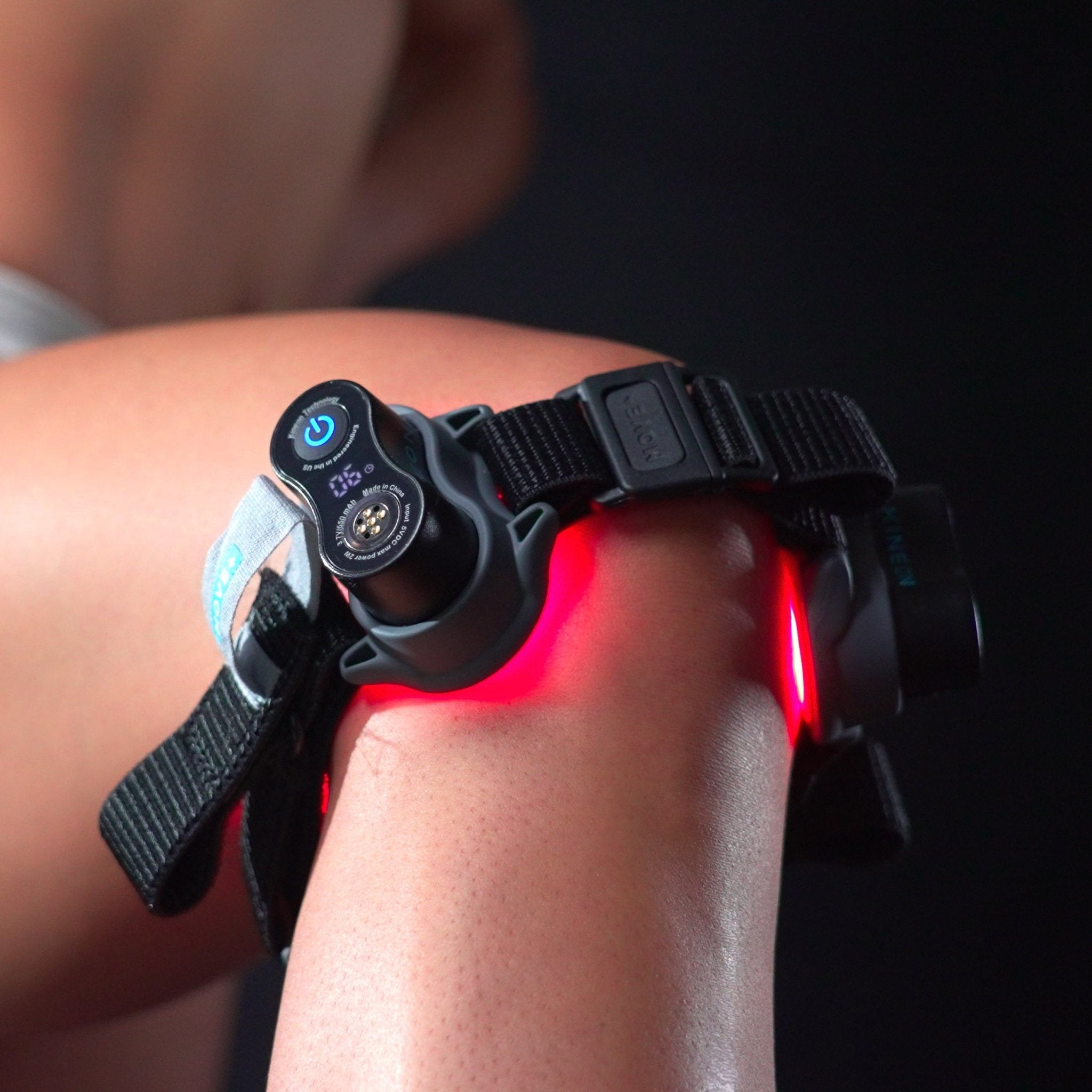
Kineon MOVE+ Pro
The Kineon MOVE+ Pro is the most clinically rigorous at-home joint therapy device we've tested. With six 100 mW laser diodes (660 nm) plus twelve 630 mW red LEDs (630 nm), it delivers over 700 mW of total output to a focused joint area. The adjustable wrap fits knee, shoulder, elbow, and ankle with magnetic attachment — and the companion app guides 10–20 min protocols backed by peer-reviewed PBM research.
"My knee pain is significantly reduced after just 2 weeks"
"I'm genuinely surprised how much relief I get each session"
- True laser diodes — deepest tissue penetration
- Clinically validated 10–20 min protocols
- Modular wrap fits 4+ joint sites
- Companion app with guided sessions
- Rechargeable — fully wireless
- Premium price ($399–$599)
- Requires eye protection when running
- Limited coverage area vs. large panels
- App required for full protocol access
How We Evaluate Wearable Joint Therapy Devices
Wearable joint therapy devices sit at the intersection of consumer wellness gadgets and regulated medical devices. Our scoring framework weights four key dimensions:
- Light Output Quality (30%) — Are diodes genuine laser or LED? What wavelengths, and are they therapeutic (630–670 nm, 808–850 nm)? Total irradiance at skin.
- Protocol Validity (25%) — Does the device follow dosing parameters supported by peer-reviewed PBM research? Is the app (if any) evidence-based?
- Wearability (20%) — Does it stay in place during treatment? Does it fit multiple joint sites? Is wireless operation supported?
- Verified User Outcomes (15%) — Community sentiment from Amazon, Reddit, and brand-direct reviews, filtered for pattern of real pain relief reports.
- Value (10%) — Cost per mW of therapeutic output; warranty and support quality.
We do not accept seeded units or early-access products without full disclosure. See our full methodology page for details.
Buying Guide: What to Look For
Laser vs. LED
Most consumer devices use LEDs. Laser diodes (Class 3B) produce coherent, collimated light that penetrates 2–5× deeper into tissue — critical for joint structures like cartilage, synovium, and tendon insertions. If a device claims "laser" but costs under $100, check the spec sheet carefully: it's likely LED-only.
Wavelength
The two most researched windows for musculoskeletal tissue are 630–670 nm (red, superficial absorption) and 808–850 nm (near-infrared, deeper penetration). The best devices combine both. 850 nm alone is common in cheaper panels; this misses the surface-layer benefits of red wavelengths.
Power Density and Dose
PBM research typically targets 3–10 J/cm² for joint applications. Calculate approximate dose: (power in mW × time in seconds) ÷ area in cm². Under-powered devices need unrealistically long sessions; over-powered ones can inhibit rather than stimulate — this is the biphasic dose-response effect unique to photobiomodulation.
Fit and Coverage
A device that slips during treatment loses contact pressure and wastes dose. Look for adjustable silicone or neoprene straps, magnetic alignment aids, and stated coverage areas. A wrap covering ~40–60 cm² is appropriate for a knee joint; smaller units may require repositioning between sessions.
📌 Bottom Line
At this price point and category maturity, the Kineon MOVE+ Pro is the only device we'd recommend without caveats. It's the only consumer wearable combining genuine laser diodes with a clinically designed protocol and a fit system that works across multiple joints. If the $399–$599 price is a barrier, a full-panel session for the affected joint (e.g., Hooga HG300 at 5–10 cm distance for 10 min) is a reasonable but less targeted substitute — while you wait for prices to come down in this category.