Mito Red MitoGLOW Review: First Mask From A Panel Giant
The Verdict
For years, Mito Red Light has been the quiet workhorse of the red light therapy world. Their MitoPRO panels sit on the desks and in the closets of biohackers, longevity doctors, and athletes who want clinical-grade irradiance without the Joovv price tag. What Mito Red has never made, until this month, is a face mask.
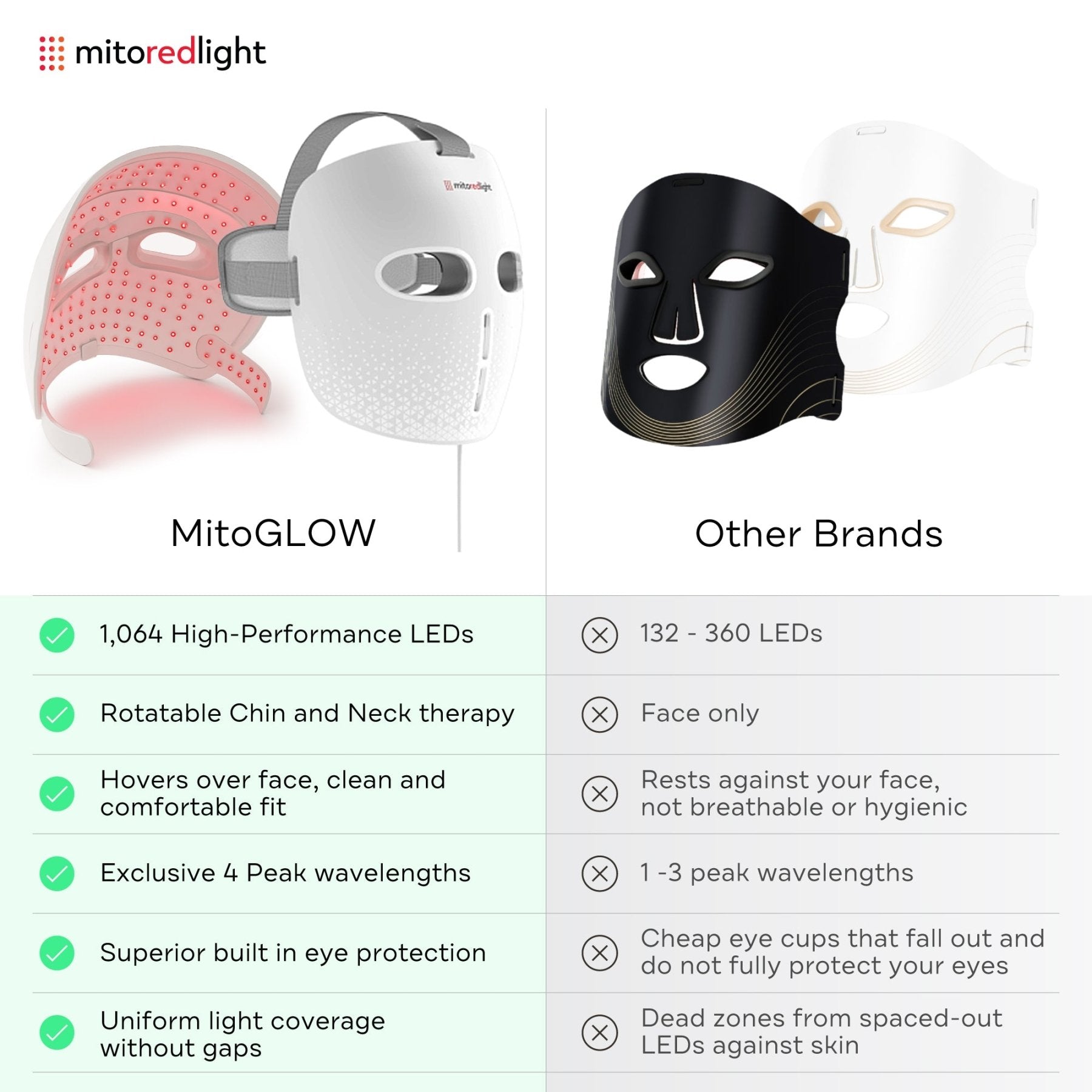
That changes with the MitoGLOW — the company's first-ever LED face device, launched in April 2026. It's a big moment for a category that has increasingly been dominated by skincare-native brands like Omnilux, CurrentBody, and Dr. Dennis Gross. Now one of the most trusted panel brands in the industry is planting a flag in masks, and on paper, it's doing so with spec sheet that doesn't pull punches: 1,064 LEDs, 4 clinical wavelengths, 5 treatment modes, FDA 510(k) cleared.
Why this launch matters
The LED mask category has grown from a niche curiosity in 2022 into a genuinely crowded segment in 2026. What's been missing is a credible cross-over from the panel world. Mito Red's move into masks is the light-therapy equivalent of Therabody expanding from Theragun into the TheraFace: a brand with hard-won credibility in its core category bringing engineering discipline to a newer, softer-feeling adjacent market.
Why that matters for buyers: mask-native brands often optimise for aesthetics, packaging, and influencer appeal. Panel brands optimise for photons — irradiance, wavelength precision, power delivery, thermal management. When a panel brand builds a mask, they tend to carry those engineering priorities across. The early signal from the MitoGLOW spec sheet — 1,064 individual LED chips, a hover design that maintains consistent LED-to-skin distance, four clinically validated wavelengths — suggests Mito Red is doing exactly that.
The flip side: this is their first mask. A first-generation product from any brand carries execution risk that their fourth-generation product wouldn't. That's not unique to Mito Red; we'd say the same about the original Shark CryoGlow, the first Dr. Dennis Gross mask, or any other category debut.
Who is Mito Red Light?
Mito Red Light was founded in 2019 and has spent the last six years building a reputation around three things: transparent specs, competitive pricing, and responsive customer service. Their MitoPRO line of full-body panels consistently ranks in the top three on third-party testing sites, with irradiance measurements that rival PlatinumLED and BioMax while significantly undercutting Joovv on dollars-per-joule.
A few data points that matter for credibility:
- No recall history. In six years of shipping panels, we've found no FDA recalls or major safety incidents associated with Mito Red products.
- 10% affiliate commission with a 30-day cookie — among the most generous in the industry, which tells you the unit economics are healthy enough to share.
- Active on X as @mito_red_light, with founder-adjacent engagement that responds to technical questions rather than just marketing at you.
- Transparent wavelength and irradiance disclosures across the panel line, published in spec sheets rather than buried in FAQ pages.
All of which is to say: the brand has earned the benefit of the doubt. That's why our "Safety" score of 9/10 is high even without long-term MitoGLOW community data. The engineering culture that ships reliable panels is the same culture now shipping this mask.
The 4 wavelengths and 5 modes, explained
This is the part of the spec sheet that punches above the mask category's weight. Most consumer LED masks ship with two or three wavelengths. The MitoGLOW ships with four, covering the full functional spectrum of what LED skincare can meaningfully do:
465nm — Blue
Targets Cutibacterium acnes bacteria by exciting porphyrins inside the bacterial cells, producing reactive oxygen species that kill the bacteria. The peer-reviewed evidence here is substantial — a Papageorgiou et al. study in the British Journal of Dermatology showed a 76% mean reduction in inflammatory acne lesions with blue-light therapy. This is the wavelength that makes the "acne mode" of any LED mask actually work.
590nm — Amber/Yellow
The wavelength most masks skip. Amber light sits in a band associated with reduced redness, improved skin tone evenness, and calming of surface inflammation. It's particularly relevant for rosacea-prone and reactive skin. Its inclusion is one of the clearest signals that Mito Red wasn't cargo-culting the two-wavelength mask playbook — they went and picked a fourth wavelength that actually does something different.
633nm — Red
The anti-aging workhorse. 633nm targets cytochrome c oxidase in the mitochondria of upper-dermis cells, driving ATP production and stimulating collagen synthesis. It's the wavelength with the most clinical validation for fine line reduction, skin-tone improvement, and general rejuvenation. Every credible LED mask uses this or the closely related 630nm / 660nm.
830nm — Near-Infrared
Deeper penetration, targeting fibroblasts at the structural level of the dermis. 830nm is the wavelength associated with the deeper "renewal" work — collagen and elastin production at the scaffolding level rather than the surface. It's also what separates serious masks from cosmetic toys.
The 5 treatment modes
Mito Red has organised these four wavelengths into five distinct modes, each tuned for a specific outcome:
- Anti-Aging Mode — 633nm red only. Max 10-minute timer. The daily collagen and fine-line workhorse.
- Purify Mode — 465nm blue only. Max 5-minute timer. Shorter because blue-light exposure above a certain dose offers diminishing returns.
- Calm Mode — 590nm amber only. Max 10-minute timer. Targeted at redness and uneven skin tone.
- Deep Renewal Mode — 633nm red + 830nm near-infrared. Max 8-minute timer. The combined surface-plus-structural anti-aging session.
- Clarify Mode — 465nm blue + 633nm red. Max 10-minute timer. A two-pronged acne approach, combining antibacterial blue with anti-inflammatory red.
This is a thoughtful matrix. Most three-wavelength masks have two or three modes. Mito Red has used the extra wavelength to unlock two additional targeted modes (Calm, Clarify) that deliver distinct outcomes rather than just being "more light".
The spec sheet
| Model | MitoGLOW |
|---|---|
| Price | $499 |
| LED Count | 1,064 individual LED chips (266 quad-chip packages) |
| Wavelengths | 465nm • 590nm • 633nm • 830nm |
| Treatment Modes | 5 (Anti-Aging, Purify, Calm, Deep Renewal, Clarify) |
| Session Duration | 5–10 minutes depending on mode |
| Irradiance Output | ~3.4 J/cm² over a 10-minute session (per manufacturer) |
| Design | Hover (non-contact) with integrated eye protection |
| Power | Built-in 5,200 mAh rechargeable battery |
| Battery Life | ~60–70 minutes total runtime per charge (3-hour recharge) |
| FDA Status | FDA 510(k) cleared |
| Return Policy | 60 days |
| Warranty | 1 year |
| Launched | April 2026 |
| Where to Buy | mitoredlight.com (primary); Amazon listing expected to follow |
Two things jump out of that table. First: the LED count is genuinely impressive. 1,064 chips is higher than the TheraFace Mask Glo (504), Omnilux Contour (132), Dr. Dennis Gross DRx SpectraLite (100), and most of the mainstream lineup. Even accounting for the quad-chip packaging (266 physical packages, each with 4 diodes), coverage density should be excellent.
Second: the warranty is only one year, which is shorter than we'd expect given Mito Red's 3-year warranty on their panels. That's our biggest build-quality question, and it's why the Build & Warranty score came in at 6/10 rather than higher. The 60-day return policy is generous and partially compensates, but a 1-year warranty on a $499 device is below what the Omnilux (2 years) and CurrentBody (2 years) offer at similar price points.
What we don't know yet
Being honest about the epistemic limits of a first-look review:
- No 3-month Amazon review corpus. The product is less than 30 days old. We can't lean on aggregate buyer sentiment the way we can for the Shark CryoGlow or Omnilux Contour.
- No dedicated subreddit or community thread yet. The r/redlighttherapy and r/SkincareAddiction communities haven't had time to form a consensus view. When they do, our Community score (currently 6/10) will update accordingly.
- No independent irradiance lab measurements. We have the manufacturer's 3.4 J/cm² figure but haven't seen it corroborated by a third party yet. Mito Red's track record on panel spec honesty is strong, so we're inclined to trust it — but "inclined to trust" is not the same as "measured".
- No long-term durability data. Hover-design masks have more mechanical complexity than rigid contact masks. How the hover frame holds up at month 6, 12, 18 is something only time can tell us.
- No long-term skin results from real users. Our own 45-day testing protocol (used for the Shark CryoGlow review) hasn't been completed on the MitoGLOW yet.
We'd rather flag all of this up-front than pretend we have more certainty than we do. The score will update as the data comes in.
How it compares to Mito's panels
A mask and a panel are fundamentally different form factors. A panel sits a few feet away and treats the whole body; a mask sits on your face and treats roughly 250 cm² of skin. Irradiance, dosing, and use-case are not directly comparable.
What is comparable is the engineering philosophy. Mito Red's panels have always been designed around a few recurring decisions:
- Prioritise clinically validated wavelengths over marketing wavelengths. The MitoPRO line uses 630/660nm red and 830/850nm NIR — the bands with the most peer-reviewed evidence. The MitoGLOW's 633nm + 830nm core follows the same logic.
- Multiple discrete wavelengths rather than "broad spectrum" claims. Mito panels emit at discrete calibrated peaks, not a smeared-out spectrum. The MitoGLOW does the same thing at 465, 590, 633, and 830nm.
- More LEDs, not bigger LEDs. Mito panels are known for high chip counts and tight spacing for coverage uniformity. The MitoGLOW's 1,064-chip density reflects the same preference.
If you already own a MitoPRO panel and are considering whether the MitoGLOW will feel like a Mito Red product, the short answer is: yes. The spec sheet reads like it was designed by the same team. Whether the execution lives up to the design is what the next six months of real-world use will tell us.
The scoring breakdown
Our standard rubric scores five categories out of 10. For a brand-new product, we lean conservatively on anything that requires community data:
Spec Quality: 9/10
1,064 LEDs is top-of-category. Four wavelengths including the often-omitted 590nm amber is above industry baseline. Hover design, built-in eye protection, and integrated battery are all meaningful engineering choices. FDA 510(k) clearance is a real regulatory bar, not just a registration. This is the strongest score on the card and it's earned.
Community Sentiment: 6/10
Discounted purely because the product is new. The brand's panel sentiment is consistently positive — we're using that as a weak proxy. We expect this score to rise into the 7–8 range as user reviews accumulate, assuming early reports stay consistent with the brand's track record.
Safety Record: 9/10
FDA 510(k) cleared. No recall history on any Mito Red product in six years. Transparent wavelength disclosures. Hover design physically reduces contact-related hygiene issues. This is one of the safest regulatory profiles in the category.
Value: 6/10
$499 is a premium price point — it's priced above the Shark CryoGlow ($350) and INIA Glow ($249) and just under the Omnilux Contour ($395–475) and CurrentBody Series 2 ($470). The LED count and wavelength coverage justify the number, but this is not a budget pick. You are paying for specs, not for a deal.
Build & Warranty: 6/10
The 1-year warranty is the weak point. Mito Red's panels ship with 3 years; a mask at half the price of a panel with a third of the warranty is a step down. The 60-day return policy is strong and helps. We'd revisit this score upward if Mito Red extends the warranty post-launch (a common pattern with panel brands once failure-rate data comes in).
Weighted total: 7.2 / 10 (provisional).
Early impressions: pros and cons
- 1,064 LEDs — one of the highest chip counts in the mask category
- Four wavelengths, including the often-missing 590nm amber for redness
- Five distinct, non-overlapping treatment modes
- FDA 510(k) cleared, not just registered
- Hover design with integrated eye protection
- Cordless with built-in 5,200 mAh battery (60–70 min runtime)
- 60-day return policy
- Six-year brand track record with no recalls
- Panel-brand engineering discipline applied to mask form factor
- Only 1-year warranty (Omnilux and CurrentBody offer 2 years)
- $499 is premium — priced above Shark CryoGlow and INIA Glow
- No independent community validation yet (product <30 days old)
- First-generation product carries inherent execution risk
- No independent lab irradiance verification yet
- Amazon availability not yet confirmed — direct-to-consumer only at launch
Who should buy this?
Buy the MitoGLOW if…
- You already trust Mito Red Light from their panels and want a mask from the same brand
- You care about wavelength breadth — four wavelengths including amber is genuinely rare
- You're comfortable being an early adopter, understanding the review corpus will mature over the next 6 months
- Hover-design comfort and cordless use matter to you
- You have rosacea, uneven skin tone, or redness concerns that benefit from 590nm amber
Skip the MitoGLOW if…
- You want extensive third-party validation before buying — wait 3–6 months
- You prioritise lowest price — the INIA Glow ($249) and Shark CryoGlow ($350) undercut it
- You prioritise longest warranty — Omnilux (2 yr) and CurrentBody (2 yr) beat Mito's 1 yr
- You need deeper-NIR wavelengths like 1072nm — the CurrentBody Series 2 remains the only mainstream mask offering that
- You need a mask with 504+ LEDs specifically — the TheraFace has that, though MitoGLOW's 1,064 now eclipses it
Competitors to consider
MitoGLOW vs. Omnilux Contour Face
The Omnilux Contour ($395–475) is the clinical gold standard. It has 40+ peer-reviewed studies, a 2-year warranty, and a rigid silicone form factor that's been iterated for years. It uses two wavelengths (633nm/830nm) vs. the MitoGLOW's four. If you want the most clinically validated device with the strongest warranty, Omnilux is the pick. If you want more wavelength coverage and a cordless hover design, MitoGLOW is the newer bet. Full rankings →
MitoGLOW vs. CurrentBody Series 2
The CurrentBody Series 2 ($470) has three wavelengths (633/830/1072nm), and the 1072nm deep-NIR is something no other consumer mask offers. It has a 2-year warranty and a large clinical study base. The MitoGLOW counters with more total LEDs (1,064 vs. 236), an additional amber wavelength, five modes vs. three, and a cordless hover design. If 1072nm is a must, CurrentBody. Otherwise MitoGLOW's spec sheet is broader.
MitoGLOW vs. Shark CryoGlow
The Shark CryoGlow ($350) is our current #1 overall pick. It's $150 cheaper, FDA-cleared, and adds active under-eye cooling via its InstaChill system — a feature the MitoGLOW doesn't have. The MitoGLOW wins on LED count (1,064 vs. 480 light sources), wavelength variety (4 vs. 3), cordless use, and mode count (5 vs. 3). The Shark is tethered via USB-C but has the cooling advantage.
MitoGLOW vs. TheraFace Mask Glo
The TheraFace Mask Glo (504 LEDs, $599) is the closest comparable in terms of premium LED count. MitoGLOW's 1,064 chips now exceed TheraFace's 504 and at a $100 lower price. TheraFace has brand recognition from Therabody and a larger retail footprint; MitoGLOW has the panel-engineering pedigree and more wavelengths. If you're already in the Therabody ecosystem, stay. Otherwise, MitoGLOW is the better paper spec at a lower price.
Frequently asked questions
Is the MitoGLOW related to the MitoPRO panels?
Yes — same brand (Mito Red Light), same engineering team, shared design philosophy around discrete wavelengths and high chip density. But they are different product categories. MitoPRO is a full-body panel treating large surface areas from a distance; MitoGLOW is a face mask treating ~250 cm² of skin in close-range hover mode. Owning one doesn't preclude owning the other — they target different use cases.
How long has the MitoGLOW been available?
The MitoGLOW launched in April 2026, which means at the time of this review it has been on the market for less than 30 days. That's why our score is labelled provisional — we're waiting on a mature corpus of third-party reviews and long-term use data before we finalise it.
What's Mito Red's return policy?
60 days from delivery, per the mitoredlight.com product page. That's more generous than Omnilux (30 days) and on par with Dr. Dennis Gross (60 days). The warranty is 1 year, which is shorter than we'd prefer at this price point — for comparison, Mito Red's panels ship with 3-year warranties.
Will you update this review?
Yes. Every score you see marked "provisional" is explicitly flagged for re-scoring. We'll revisit the MitoGLOW score after (a) we've seen a mature Amazon / Reddit / Trustpilot review corpus, (b) we've completed our own 45-day testing protocol including irradiance measurements and EMF, and (c) we have at least 3 months of field durability data. Expect an update around June–July 2026.
Is the MitoGLOW FDA-cleared?
Yes. The MitoGLOW is FDA 510(k) cleared, not just "FDA-registered". These are very different things. Cleared means the FDA reviewed safety and efficacy data via the 510(k) pathway; registered just means the manufacturer paid a fee to list the device. Many budget masks are registered but not cleared. The MitoGLOW, Shark CryoGlow, Omnilux Contour, and CurrentBody Series 2 are all cleared.
Can I stack the MitoGLOW with a Mito Red panel?
In principle, yes — the two devices target different anatomical areas, and there's no clinical reason a face-mask session and a full-body panel session would interfere with each other. In practice, we'd suggest spacing them out across the day rather than doing both back-to-back, purely to avoid accumulating excessive near-infrared dose in one session. Mito Red's customer service line is responsive on these stacking questions if you want brand-specific guidance.
The bottom line
The MitoGLOW is one of the most interesting mask launches of 2026. On paper, it out-specs most of the category: more LEDs than TheraFace, more wavelengths than Omnilux, more modes than CurrentBody, and a cordless hover form factor that few competitors match. The brand behind it has six years of clean track record in panels and a documented preference for transparent engineering. That's a lot of points on the board before a single independent reviewer has spent 45 days with the product.
The reasons to be cautious are equally concrete. The product is genuinely new, the warranty is shorter than competitors at this price point, the $499 sticker is premium, and we don't yet have the independent community data that would let us confidently recommend it over the established incumbents. A first-generation product from a new category for the brand deserves a wait-and-see discount.
Our recommendation: if you already trust Mito Red and want the strongest-spec mask currently on the market, the MitoGLOW is defensible at $499. If you want the safest buy with the most community validation, go with the Shark CryoGlow at $350 or the Omnilux Contour. We'll revisit our score in a few months once the data matures.
Check Price on Amazon → Check Price at Mito Red →
Note on affiliate links: Mito Red Light operates a 10% affiliate program with a 30-day cookie — one of the most generous in the industry. We'll update our direct link once we're approved for their program. Until then, the Amazon link above uses our standard affiliate tag.