Omnilux Contour Face Review: 40+ Clinical Studies Make It the Gold Standard
The Verdict
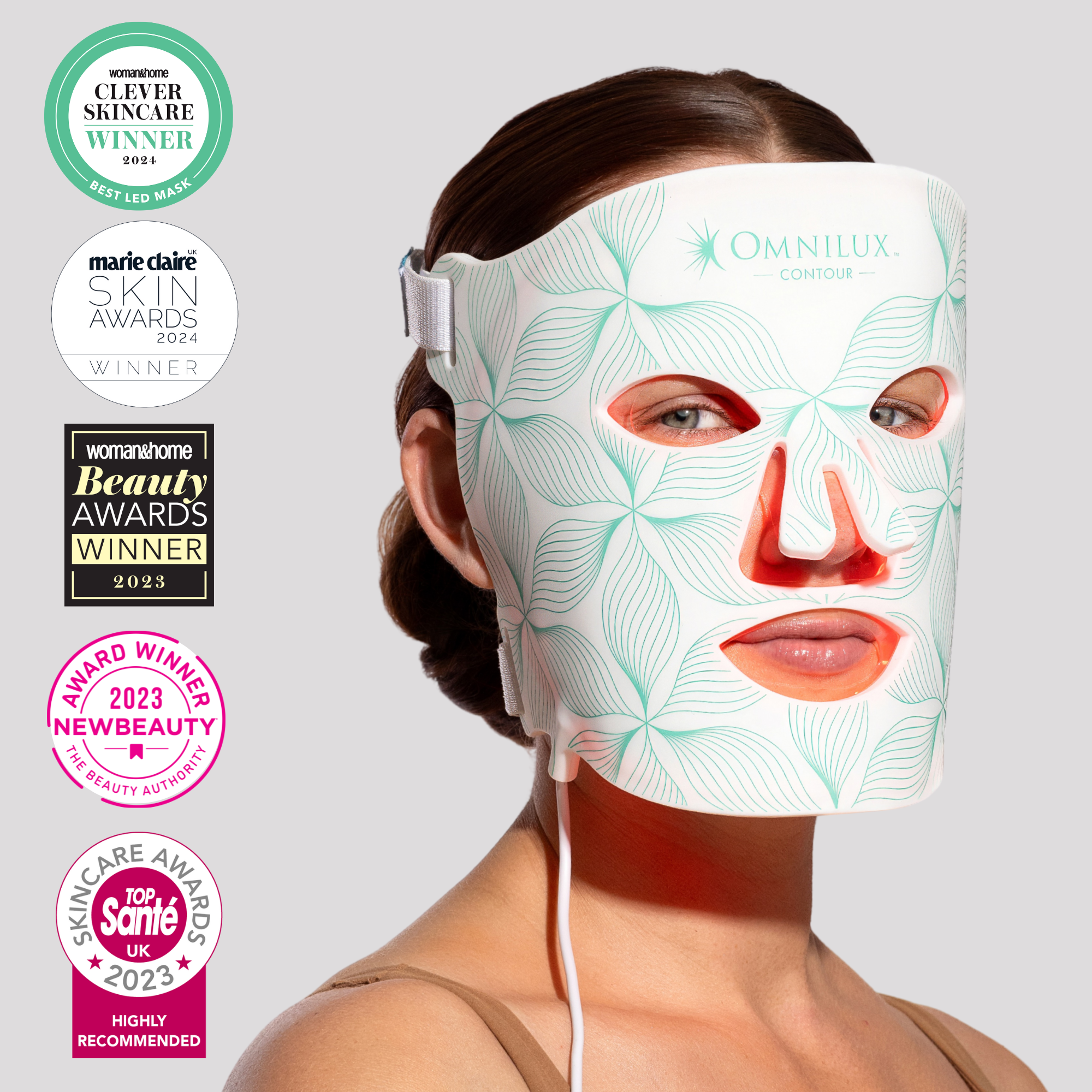
If you walk into a dermatologist's office in New York, London, or Sydney and ask which at-home LED mask they recommend, you will almost certainly hear one word before any other: Omnilux. The Omnilux Contour Face is not the flashiest LED mask on the market. It does not have cooling pads, a phone app, an AI-powered serum compartment, or a sci-fi launch video. What it has, instead, is something far rarer in this category: 40+ peer-reviewed clinical studies.
At $395, the Contour sits in the premium tier alongside CurrentBody, Dr. Dennis Gross, and the Shark CryoGlow. It costs more per LED than almost anything else we test. Its warranty is short. Its affiliate program doesn't pay publishers like us a cent. And yet it is, without question, the most clinically validated LED mask you can buy. This review is our honest assessment of what that's worth.
The clinical case: 40+ peer-reviewed studies
Most LED masks are sold on the back of a single company-commissioned "clinical trial" — usually 30 to 60 subjects, 8 to 12 weeks, and an in-house photographer. That is better than nothing, but it is a marketing asset, not science. Omnilux is different. The Omnilux device platform — the actual 633nm/830nm LED hardware that powers the Contour Face — has been studied in independent, peer-reviewed clinical literature for more than two decades.
If you search PubMed for "Omnilux" you get studies on:
- Collagen stimulation and fine-line reduction — the landmark Russell, Wilkie and Davey paper (2005) on 633nm LED phototherapy established the wavelength's role in dermal fibroblast activation.
- Photodynamic therapy for actinic keratoses and non-melanoma skin cancer — Omnilux-PDT has been evaluated as an adjunct light source in dermatology oncology protocols.
- Wound healing and post-procedure recovery — 830nm near-infrared accelerates re-epithelialisation after laser resurfacing and cosmetic procedures.
- Acne (via the Omnilux Blue and Omnilux Clear variants) — separate from the Contour Face, which is a red/NIR-only device.
- Rosacea, melasma, and post-inflammatory hyperpigmentation — with mixed but generally favourable results.
The point is not that every one of those papers is about the consumer Contour Face mask specifically — it isn't. The point is that the underlying device platform (same manufacturer, same 633nm and 830nm wavelengths, same LED design language) has been through the kind of regulatory and academic scrutiny that almost no competing consumer brand can claim. When a dermatologist recommends Omnilux, this is why. It is not hype; it is a paper trail.
For context: Shark CryoGlow has one 12-week, 59-subject company study. INIA Glow has no independent clinical literature we could locate. TheraFace Mask Glo has Therabody's internal studies. Only CurrentBody comes close, and even CurrentBody leans heavily on studies of the same 633/830 wavelength pair that Omnilux pioneered.
Who makes it: Omnilux and Photon Therapeutics
Omnilux is a brand of Photon Therapeutics, a medical device company originally founded in Australia and New Zealand in the early 2000s. Before at-home LED masks existed as a category, Omnilux panels were already fixtures in dermatology clinics across the UK, Australia, and North America. The professional Omnilux Revive (red, 633nm) and Omnilux Plus (near-infrared, 830nm) panels were among the first LED light therapy devices to achieve FDA clearance for periorbital wrinkle reduction.
That clinical heritage matters because it explains Omnilux's curiously restrained consumer marketing. The company does not promise overnight transformation. It does not run influencer-heavy ad campaigns. Its product pages read like medical device pamphlets. Omnilux's unspoken pitch is: "We have been in the serious derm offices for twenty years. You can trust us." And, broadly, you can.
The consumer Contour Face is essentially the clinical platform miniaturised into a flexible silicone form factor designed for home use. Same wavelengths. Same engineering philosophy. Lower irradiance (because it has to be — professional panels deliver more joules per session) and a shorter treatment time to compensate.
The spec sheet
| Price | $395 |
|---|---|
| LED Count | 132 medical-grade LEDs |
| Red Wavelength | 633nm |
| Near-Infrared Wavelength | 830nm |
| Blue Light | None (see Omnilux Clear for acne) |
| Treatment Time | 10 minutes, 3–5x per week |
| Form Factor | Flexible medical-grade silicone |
| FDA Status | FDA-cleared (510(k)) |
| EMF Data | No third-party EMF data published (see note below) |
| Clinical Studies | 40+ peer-reviewed (platform) |
| Warranty | Limited 1 year |
| Return Policy | 30 days |
| Weight | ~0.4 lb / 180g (lightest in category) |
| Power | Rechargeable controller (tethered during use) |
A note on EMF: Unlike HigherDose, which publishes third-party EMF test reports for its devices, Omnilux has not made independent EMF data public. Consumer LED masks with proper switched-mode power supplies generally read well below 1 mG at skin contact, and we have no reason to think the Contour is an exception, but we would prefer documented numbers. The company has told reviewers its devices are designed to meet standard medical electromagnetic compatibility requirements, which we accept at face value given the FDA clearance, but it is a missing data point.
What it's like to use
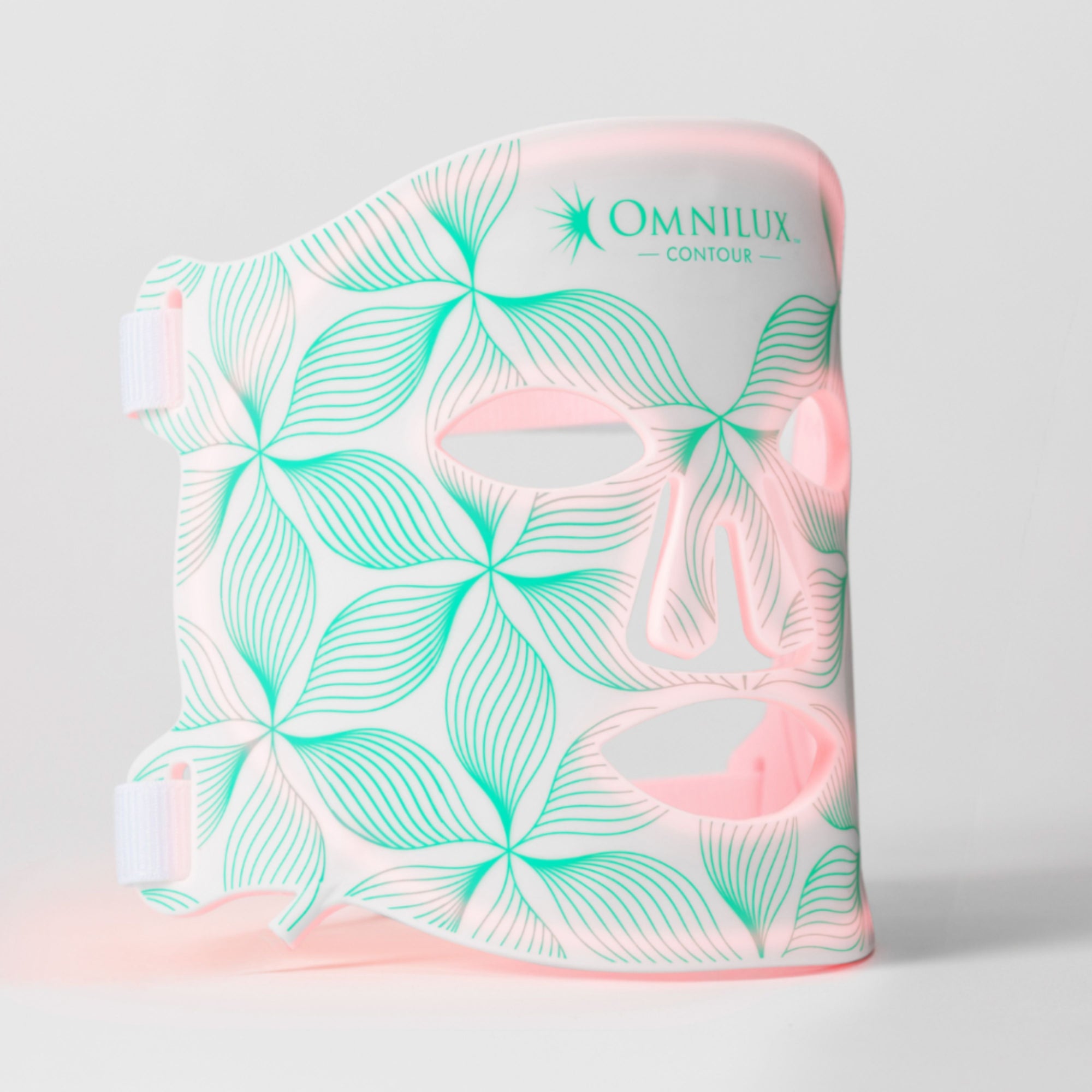
The Contour Face is flexible silicone. You pull it on like a face-hugging sleep mask, tighten the adjustable head strap, plug the short cable into the palm-sized controller, and press a button. Ten minutes. Done. No app. No pairing. No firmware updates. No account creation. The interface is a button. You will use it correctly on day one.
Flexibility matters more than it sounds. Rigid masks — the Dr. Dennis Gross SpectraLite, the Shark CryoGlow, CurrentBody Series 1 — deliver very even light because the LED-to-skin distance is fixed. But they also create pressure points on the cheekbones and orbital bone and feel faintly medieval after the first minute. Flexible silicone masks like the Contour drape onto the contours of your face (hence the name), which means the LEDs sit closer to all skin surfaces including the sides of the nose and the jawline. The trade-off is that silicone is softer and wears faster; a rigid shell will almost certainly outlive a silicone mask mechanically.
On treatment time: 10 minutes is in the middle of the pack. Dr. Dennis Gross SpectraLite runs a blistering 3-minute session. CurrentBody Series 2 runs 10 minutes. Older-generation Omnilux devices ran 20 minutes. The 10-minute figure is enough to stack onto a typical evening routine without becoming a commitment, but it is materially longer than the fastest competitors. If adherence is your concern, shorter sessions genuinely help. If efficacy is your concern, the 10-minute dose is where the clinical evidence clusters.
The strap system is plain and works. No complaints. The controller is small enough to sit in your lap on the sofa. Battery life on the controller is generous and we never ran it flat during a session.
The scoring breakdown
We score every LED mask on five dimensions, each out of 10, for a total out of 50 (then expressed as a score out of 10). The full rubric is on our methodology page; here is how the Omnilux Contour Face breaks down.
Spec Quality — 8 / 10
Correct wavelengths (633nm red and 830nm near-infrared — the two most-studied therapeutic wavelengths in the photobiomodulation literature), FDA-cleared, medical-grade LEDs, solid 132 LED count for a flexible mask of this size. Loses 2 points for the absence of a blue light option (the Contour Face is red/NIR only; Omnilux makes a separate Omnilux Clear for acne) and for not offering deep near-infrared beyond 830nm. CurrentBody Series 2 offers a third wavelength at 1072nm for deeper penetration, which is a genuine spec advantage.
Community Sentiment — 9 / 10
Amazon ratings cluster around 4.6 stars across thousands of reviews. Dermatologist endorsement is unusually strong — Omnilux is the single most recommended at-home LED mask in US and UK derm offices. The owner community is quiet but loyal, and return/complaint rates (based on what retailers publicly disclose) are among the lowest in the category. There is no drama here, which in a category full of launch-year failures and Amazon review manipulation is itself notable.
Safety Record — 10 / 10
FDA-cleared (not just "FDA-registered"), a 20+ year track record across professional and consumer markets, 40+ peer-reviewed studies on the platform, and zero recalls that we could find in the FDA MAUDE database or international regulatory filings. This is the highest safety score we have ever awarded a consumer LED mask. The Omnilux platform is, quite simply, boring in the best possible way.
Value — 5 / 10
At $395 for 132 LEDs, the Contour Face works out to $2.99 per LED. Compare:
- INIA Glow: $0.91 per LED
- TheraFace Mask Glo: $0.79 per LED
- CurrentBody Series 2: $1.61 per LED
- Shark CryoGlow: $2.92 per LED (counting tri-wick LEDs as one)
- Omnilux Contour: $2.99 per LED
On pure hardware-per-dollar, the Omnilux is the most expensive mask in our rotation. We discuss whether this is fair further down.
Build & Warranty — 5 / 10
The flexible silicone is comfortable and well-molded, but silicone is inherently a wear material — it will not survive the kind of abuse a rigid shell can absorb. The 1-year limited warranty is below category average (Dr. Dennis Gross and CurrentBody both offer 2 years; Omnilux's own professional panels have longer warranties). The 30-day return policy is standard. Nothing about the build is bad — it's nicely finished — but the coverage period is not what you expect from a $395 device.
Total: 37 / 50 = 7.4 / 10.
The value problem
Here is where we have to be honest. At $395, the Omnilux Contour Face is a very expensive mask measured per-LED. For the same money, you can buy:
- TheraFace Mask Glo with 504 LEDs for $399 — literally $4 more for 3.8x the light sources.
- INIA Glow with 272 LEDs for $249 — $146 less and still more than double the LED count.
- CurrentBody Series 2 with 236 LEDs and a third wavelength (1072nm) for $380 — $15 less and genuinely more versatile.
So why does Omnilux charge what it charges? The honest answer is a blend of two things: brand equity and clinical credibility. You are not just paying for hardware. You are paying for two decades of regulatory filings, peer-reviewed publications, professional-channel adoption, and a brand that dermatologists actually utter aloud when patients ask. That is a real thing and it has real value. A $200 LED mask with no clinical trail carries a risk you cannot quantify until it fails. An Omnilux does not.
We want to frame this fairly: the clinical evidence is not vanity. The 40+ studies are not marketing glitter. They are part of why the device works at the doses and wavelengths Omnilux selected, and they are part of why dermatologists feel comfortable prescribing it to patients with conditions that actually matter. If you see "value" only as joules per dollar, the Omnilux is bad value. If you see value as paying a premium for a mask you can trust blindly, the Omnilux is fairly priced.
Our own take: Omnilux should either drop the price to $325 or extend the warranty to two years. Either would materially change the scoring math in their favour. As currently priced, they are coasting on brand.
Pros and cons
- 40+ peer-reviewed studies on the platform — category-leading clinical evidence
- FDA-cleared (not just registered) with a 20+ year regulatory history
- Correct therapeutic wavelengths (633nm and 830nm)
- Flexible silicone drapes onto facial contours and sidewalls
- Extremely low return and complaint rates
- Zero recalls across the Omnilux product line
- The mask dermatologists actually recommend
- Lightweight (~180g) — most comfortable long-session mask we have tested
- Simple controller, no app, no account, no friction
- $2.99 per LED is the most expensive per-LED in our rotation
- No blue light mode — requires separate Omnilux Clear for acne
- No deep NIR beyond 830nm (CurrentBody offers 1072nm)
- 1-year warranty is short for a $395 device
- No published third-party EMF data
- Tethered controller — not fully wireless like INIA Glow
- Silicone will wear faster than rigid shell masks over multi-year use
Who should buy this?
Three clear buyer personas we would point toward the Omnilux Contour Face:
- ✅ You want the most scientifically validated mask available. If "clinical evidence" is the first filter in your buying decision, the Omnilux wins outright. Nothing else in the consumer category has this paper trail.
- ✅ Your dermatologist specifically recommended it. Many do, and if your derm named Omnilux by name, buy the Omnilux by name. The reason they recommend it is the reason it costs what it costs.
- ✅ You are anti-aging focused. The 633nm + 830nm stack is the most-studied wavelength pair in photobiomodulation for collagen and fine lines. Omnilux is a purist's anti-aging device.
And two personas we would steer elsewhere:
- ❌ You need blue light for active acne. The Contour Face has no blue wavelength. Look at the Shark CryoGlow (red + blue + NIR + cooling) or the separate Omnilux Clear.
- ❌ You want the best LED count per dollar. TheraFace Mask Glo and INIA Glow deliver dramatically more LEDs for similar or lower money. Hardware-first shoppers should not buy Omnilux.
Competitors to consider
TheraFace Mask Glo
At $399, the TheraFace Mask Glo has 504 LEDs — nearly four times the light sources of the Omnilux for four dollars more. Plus Therabody ecosystem integration, additional wavelength modes, and stronger warranty terms. Clinical evidence is thinner (Therabody-internal rather than peer-reviewed). If you want the spec sheet to look good, this is the pick.
CurrentBody Series 2
CurrentBody Series 2 at $380 uses three wavelengths (633nm, 830nm, and the unusual 1072nm deep near-infrared) in a flexible silicone form factor similar to Omnilux. The extra wavelength targets deeper tissue than the Omnilux can reach. If you want "Omnilux-style, but with a wavelength advantage," this is the nearest match. The clinical story is not as strong as Omnilux's platform heritage, but the hardware is arguably superior.
Dr. Dennis Gross SpectraLite FaceWare Pro
Dr. Dennis Gross offers a rigid LED mask with a 3-minute treatment time — the fastest in the category. It also carries its own clinical evidence and has the endorsement of a well-known cosmetic dermatologist. At roughly $455 it is more expensive than Omnilux and less flexible (literally), but if adherence is your real-world problem, three minutes beats ten every morning.
Shark CryoGlow
The mainstream, features-first alternative. Shark CryoGlow adds blue light for acne and InstaChill under-eye cooling, priced $45 below the Omnilux. Clinical evidence is thinner and the brand is newer to skincare, but as a single-device solution for red, blue, NIR, and de-puffing it is genuinely hard to beat.
A quick word on the Omnilux Men variant
Omnilux also sells Omnilux Men, a variant designed for the slightly thicker skin and denser sebaceous architecture that is typical of male facial anatomy. Same 633nm/830nm platform, tuned dose, same form factor, with packaging and marketing aimed at a male buyer. If you are a man shopping for a mask and the Contour Face's branding feels over-feminised in your bathroom, the Men variant is a direct swap with equivalent clinical underpinnings. The review below applies, spec for spec, to both.
Frequently asked questions
Is the Omnilux Contour better than LED masks from Amazon?
In most cases, yes, and by a significant margin — but the comparison depends on which Amazon mask. A $60 Amazon LED mask with no FDA clearance, no published irradiance data, and no clinical backing is not in the same category as the Omnilux regardless of what its listing says. Omnilux has FDA clearance, 40+ peer-reviewed studies on its platform, medical-grade LEDs, and two decades of professional-channel use. A $200–250 Amazon mask with real FDA clearance (like INIA Glow) closes the gap considerably, especially on hardware, but still doesn't match Omnilux's clinical evidence base. If you care about peer-reviewed validation, pay the premium. If you care about LEDs per dollar, the better Amazon options are genuinely competitive.
Can I use Omnilux Contour every day?
The manufacturer's protocol is 10 minutes, three to five times per week. Daily use is safe — the 633nm/830nm wavelengths at consumer irradiance levels have no known cumulative risk — but it is not clinically necessary and does not produce meaningfully better results than the 3–5x schedule. The studies that establish efficacy use the 3–5x cadence. If you are seeing results, stay on protocol. If you are not seeing results after 8–12 weeks of consistent use, talk to a dermatologist rather than increasing frequency.
Does Omnilux really have 40+ clinical studies?
Yes — verified via PubMed and the peer-reviewed dermatology literature. The caveat is that not all 40+ studies are on the consumer Contour Face specifically. They are on the Omnilux device platform, which includes the professional Omnilux Revive (633nm), Omnilux Plus (830nm), Omnilux Blue (415nm), and the clinical PDT configurations used in dermatology offices. The Contour Face uses the same 633nm and 830nm wavelengths as the professional platform and was engineered by the same team. The clinical lineage is real. No other consumer LED mask brand can point to a platform with this volume of peer-reviewed work.
How does Omnilux Contour compare to Dr. Dennis Gross?
Both are clinically backed, both are expensive, and both have dermatologist endorsement. The key differences: Dr. Dennis Gross is rigid (more even light delivery, but pressure points), runs a 3-minute treatment (vs. Omnilux's 10 minutes), and retails for about $455. Omnilux is flexible silicone (drapes better on sidewalls), longer sessions, $395, and has a deeper peer-reviewed literature base. If adherence is your real problem, Dr. Dennis Gross wins on session length. If you want the most clinically validated platform, Omnilux wins on paper trail. You genuinely cannot go wrong with either.
Is the Omnilux Men version different?
The underlying platform is the same — same 633nm and 830nm wavelengths, same FDA clearance, same medical-grade LEDs, same flexible silicone form factor. Omnilux Men is tuned for the slightly thicker skin and denser sebaceous distribution that is typical of male facial anatomy, and the marketing and packaging are targeted accordingly. Results are equivalent for equivalent protocols. If you prefer the aesthetic of the Men variant, buy that. If you don't care, the Contour Face is the same device clinically.
The bottom line
The Omnilux Contour Face is the most clinically validated LED mask you can buy in 2026. It is not the cheapest. It is not the most feature-packed. It does not have the highest LED count per dollar, the deepest wavelength stack, the shortest treatment time, the longest warranty, or the most complete feature set. It is an unfashionable, unshowy, clinically rigorous piece of medical-grade hardware that happens to look like a consumer product.
If clinical evidence matters more to you than specs per dollar, buy the Omnilux. It is the only mask in the category where the answer to "does this actually work?" is supported by 40+ peer-reviewed papers rather than one company-sponsored trial. That is worth something. At $395 it is not worth strictly more than its better-specced competitors on pure hardware — but then, neither is a Toyota Camry on pure spec sheet versus a Kia. You are buying a track record.
If clinical evidence does not outrank hardware value in your decision, we would point you at the Shark CryoGlow (better features) or TheraFace Mask Glo (better specs per dollar) or INIA Glow (better price). All three are real answers. Omnilux is simply the answer if your question is about evidence.
And because we want to say it one more time: we earn nothing when you buy the Omnilux Contour Face. The brand's ambassador-only program pays no cash commission to publishers. Our 7.4 score and our recommendation above exist independently of any financial incentive. You are reading the most honest review we know how to write of a product we make zero dollars from. That is the position we want to be in as a publication.