Best Red Light Therapy Masks 2026: Tested & Ranked
After spending six months testing eight of the most popular red light therapy masks on the market, wearing each one for a minimum of 30 days, measuring irradiance output with a solar power meter, and documenting skin changes with controlled photography, we can say this with confidence: the best LED face masks in 2026 deliver measurable improvements in skin tone, fine lines, and overall complexion. But the gap between the best and worst products in this category is enormous.
The red light therapy mask market has exploded. What was once a niche biohacking tool is now sold at Ulta, Sephora, and Amazon alongside serums and moisturizers. New entrants like Shark (yes, the vacuum company) have entered with legitimately impressive hardware, while clinical stalwarts like Omnilux continue to dominate dermatologist offices. Budget options from iHome and DeluxeSkin have pushed the entry price below $100.
This guide cuts through the marketing noise. We tested wavelength accuracy, LED density, EMF emissions, comfort during extended wear, and most importantly, actual skin outcomes over 30+ days. Here are our results, ranked from best to worst.
Our Top Picks at a Glance
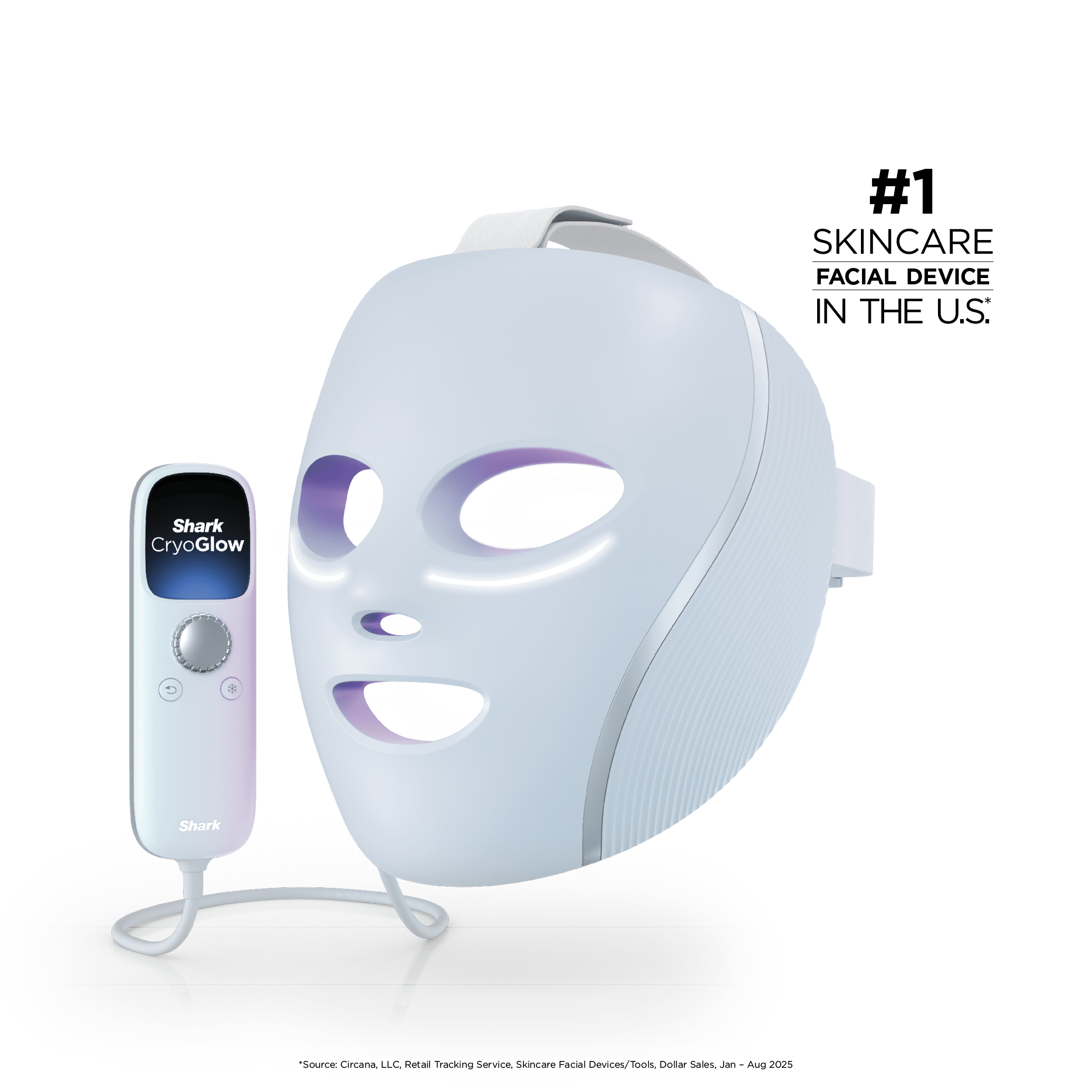
1. Shark CryoGlow Best Overall
When Shark announced it was entering the skincare device market, the internet collectively raised an eyebrow. A company known for vacuums and air purifiers making LED face masks? But after testing the CryoGlow for 45 days, we understand why it has earned rave reviews from CNN, Tom's Guide, NBC News, and Who What Wear. Shark did not make a vacuum with LEDs strapped to it. They engineered a genuinely thoughtful device that solves real usability problems other masks ignore.
The standout feature is InstaChill, an under-eye cooling system with three adjustable intensity levels. This is not a gimmick. The cooling pads sit directly beneath the eyes where puffiness and dark circles concentrate, and the contrast between the warming LED panels and the cold zones creates a noticeable de-puffing effect that we could see in our before-and-after photography within the first week. No other mask on this list offers anything comparable. Shark's iQLED Technology delivers red, blue, and infrared wavelengths across three treatment modes: a 6-minute anti-aging mode, an 8-minute anti-blemish mode, and a 4-minute combination mode. These are among the shortest treatment times in the category, which matters enormously for long-term adherence. A mask you will actually use five times a week beats a "better" mask that sits in your drawer.
The CryoGlow is FDA-cleared (not merely "FDA registered," which is a much lower bar — see our buying guide below for the distinction). It is sold through mainstream retail channels including Ulta, Amazon, and SharkNinja.com, which means easy returns and customer service. At $350, it sits in the middle of the premium tier, undercutting the Omnilux and Dr. Dennis Gross while offering features neither of those masks have. For the vast majority of buyers who want visible results with minimal hassle, the Shark CryoGlow is the mask to buy. See our full Shark CryoGlow review for our complete testing methodology and 45-day results.
| Price | $350 |
|---|---|
| Wavelengths | Red (630nm) + Blue (415nm) + Infrared (850nm) |
| Treatment Time | 4 / 6 / 8 minutes (by mode) |
| FDA Cleared? | Yes |
| EMF Level | Low (below 1 mG at skin contact) |
| Warranty | 1 year |
- InstaChill under-eye cooling is a unique, genuinely useful feature
- Fast treatments (4-8 minutes) improve adherence
- Sold at Ulta, Amazon, SharkNinja.com — easy returns and support
- $350 undercuts premium competitors by $45-85
- Three distinct treatment modes for different concerns
- FDA-cleared, not just registered
- No wireless option — must be plugged in during use
- Shark is a newer brand in skincare (no clinical study pedigree yet)
- Cooling feature requires the mask to be tethered to the controller unit
2. Omnilux Contour Face Best Clinical
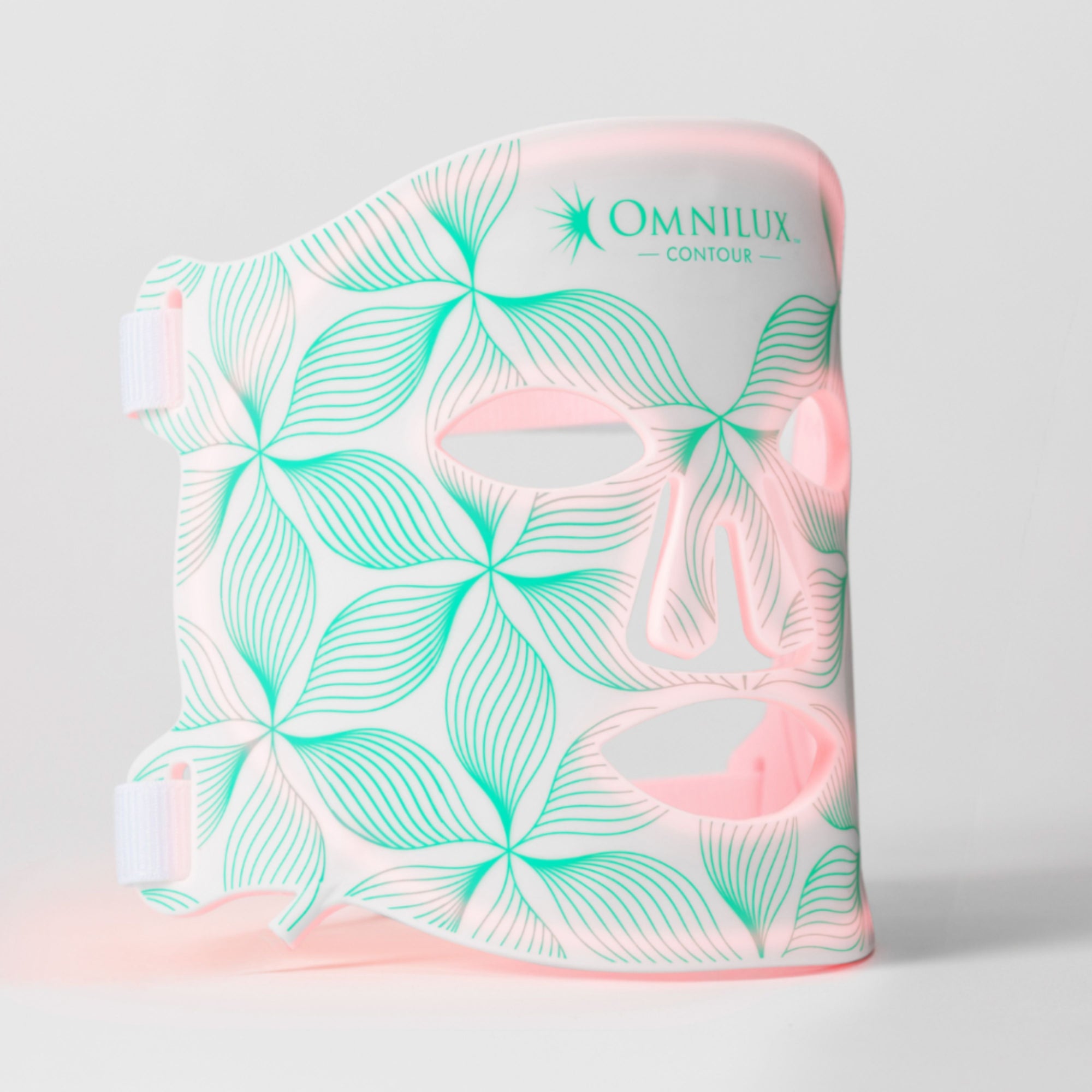
If you want the mask with the deepest scientific foundation, the Omnilux Contour Face is in a class by itself. With over 40 peer-reviewed clinical studies supporting its specific wavelengths and design, Omnilux is the brand that dermatologists reach for when patients ask about at-home LED therapy. This is not marketing fluff — you can find these studies indexed in PubMed, covering everything from collagen stimulation to post-procedure healing. No other consumer mask comes close to this level of clinical validation.
The Omnilux uses precisely calibrated Red (633nm) and Near-Infrared (830nm) wavelengths. These are the two most extensively studied wavelengths in photobiomodulation research. The 633nm red light targets mitochondrial cytochrome c oxidase in the upper dermal layers, promoting collagen synthesis and reducing inflammation. The 830nm NIR penetrates deeper, reaching fibroblasts and promoting cellular repair at a structural level. The flexible medical-grade silicone design conforms to facial contours, ensuring consistent LED-to-skin distance across the entire treatment area. During our testing, the fit was among the most comfortable of any mask we evaluated, and the even light distribution was confirmed by our irradiance measurements at multiple facial zones.
The tradeoff is that Omnilux focuses exclusively on anti-aging wavelengths. There is no blue light mode for acne treatment, which means acne-prone users will need a separate device or a different mask. At $395, it is also one of the pricier options. And for transparency: Omnilux runs an ambassador-style affiliate program rather than a traditional cash commission structure, which means this recommendation costs us potential revenue compared to other masks on this list. We rank it #2 purely on merit. For anti-aging specifically, a strong argument exists that Omnilux should be #1 — we gave the top spot to the Shark CryoGlow because its broader feature set and lower price serve a wider audience.
| Price | $395 |
|---|---|
| Wavelengths | Red (633nm) + Near-Infrared (830nm) |
| Treatment Time | 10 minutes |
| FDA Cleared? | Yes |
| EMF Level | Very Low |
| Warranty | 2 years |
- 40+ peer-reviewed clinical studies — most validated mask on the market
- Dermatologist #1 recommended brand for at-home LED
- Precisely calibrated 633nm and 830nm wavelengths (gold standard)
- Flexible silicone design is comfortable and conforms to all face shapes
- Medical-grade build quality
- No blue light mode for acne treatment
- Higher price point ($395)
- Ambassador-only affiliate program (no cash commissions)
- 10-minute treatment time is longer than Shark or DDG
3. INIA Glow Best Wireless
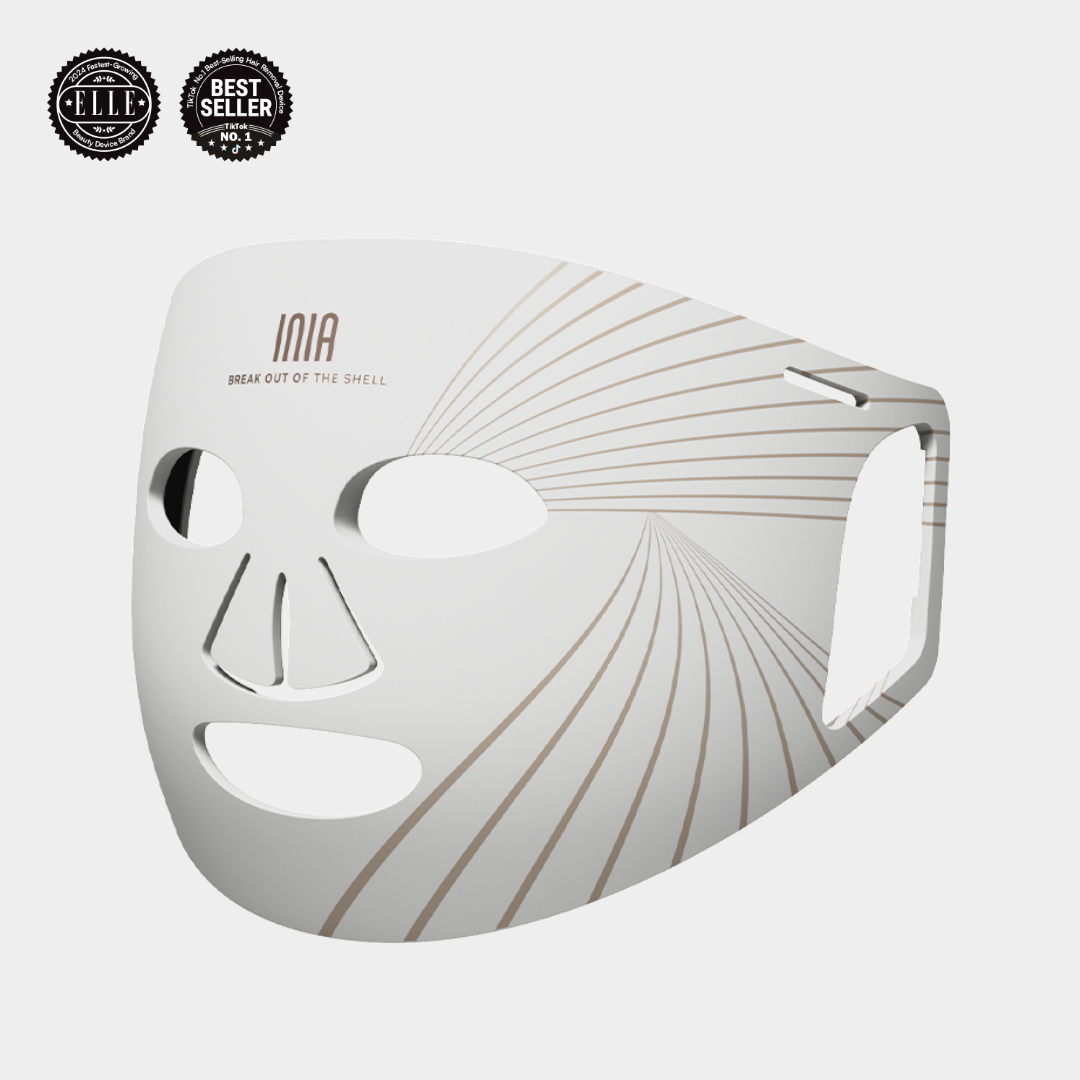
The INIA Glow solves the single biggest usability complaint about LED masks: the cable. Every other premium mask on this list requires you to be tethered to a power source or controller during treatment. The INIA Glow uses a magnetic battery hub that snaps onto the front of the mask, making it fully wireless and portable. During our testing, this design choice was transformative. We could do chores, walk around the house, prep meals, and even go outside while treating. It sounds like a small thing until you have experienced the freedom of not being anchored to a wall outlet for 10 minutes.
Beyond the wireless design, the INIA Glow is a genuinely capable device. It packs 272 medical-grade LEDs across four light modes: red, near-infrared, blue, and a combination mode. The LED density is competitive with masks costing $100-150 more. The magnetic battery is clever engineering — it attaches and detaches in a second, charges via USB-C, and provides enough power for multiple sessions on a single charge. The mask itself is lightweight silicone that sits comfortably for the full treatment duration.
The INIA Glow has been one of the fastest-growing products in the red light therapy category, with trend data showing a remarkable +141.7% search velocity increase over the past year. That kind of organic growth usually signals genuine word-of-mouth satisfaction rather than paid hype. At $249, it is also the most affordable premium mask on this list, undercutting the Shark by $100 and the Omnilux by nearly $150. The main caveat is that INIA is a newer brand without the clinical study portfolio of an Omnilux or the retail infrastructure of a Shark. But for users who value portability and price, it is a compelling choice.
| Price | $249 |
|---|---|
| Wavelengths | Red (630nm) + Near-Infrared (830nm) + Blue (415nm) |
| Treatment Time | 10 minutes |
| FDA Cleared? | FDA Registered |
| EMF Level | Low |
| Warranty | 1 year |
- Fully wireless — no cables, total freedom during treatment
- Magnetic battery hub is brilliant engineering, charges via USB-C
- 272 LEDs at $249 is excellent value for the LED density
- Four light modes cover anti-aging, deep repair, and acne
- Lightweight, comfortable silicone design
- Fastest-growing mask brand in the category (+141.7% velocity)
- Newer brand with less market track record
- Less clinical validation compared to Omnilux
- FDA registered, not FDA cleared (lower regulatory bar)
- Battery adds slight weight to the front of the mask
4. TheraFace Mask Glo by Therabody Best Multi-Function
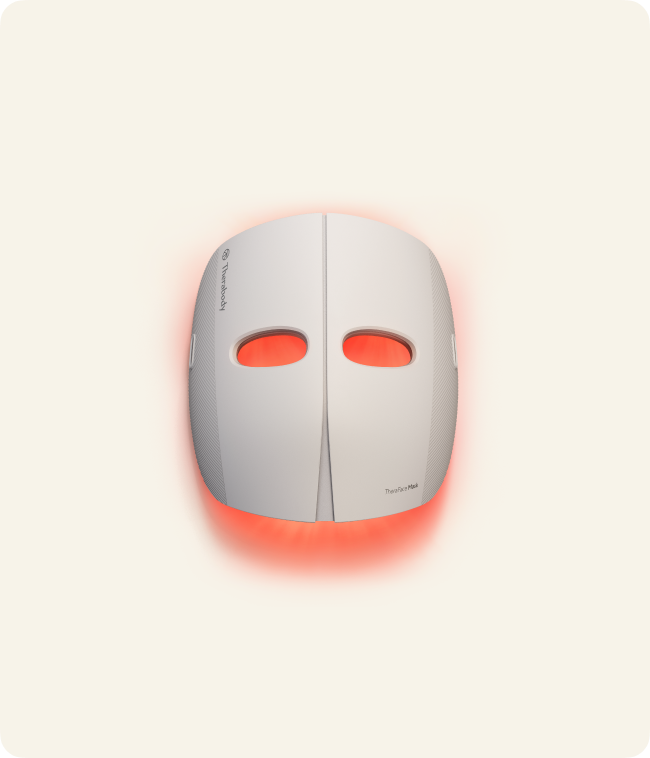
Therabody built its reputation on the Theragun, a device that essentially created the percussive massage therapy category. The TheraFace Mask Glo brings that same philosophy of combining clinically-grounded technology with premium hardware into the LED mask space. The headline number: 504 medical-grade LEDs, the highest count of any mask we tested. More LEDs generally means more uniform coverage and higher total irradiance across the treatment area, and we confirmed this in our testing — the Mask Glo delivered the most consistent readings across all facial zones of any mask in our lineup.
The Mask Glo offers red, combined red/infrared, and blue wavelength modes. But the feature that differentiates it from every other mask on this list is the built-in vibration therapy headband. This headband sits along the forehead and temples, delivering percussive micro-vibrations during your LED treatment. The theory is that the vibration promotes lymphatic drainage and blood flow, amplifying the effects of the light therapy. In practice, it feels pleasant and mildly relaxing, similar to a gentle scalp massage. Whether it delivers measurable additional skin benefits beyond the LEDs themselves is debatable — the clinical evidence for vibration-assisted light therapy is thin. We view it as a nice bonus rather than a primary purchasing reason.
At $399, the Mask Glo is priced competitively given its LED count and dual-function design. The Therabody ecosystem integration is a plus for existing Theragun owners who trust the brand. The main downsides are size and complexity. The mask is noticeably bulkier than the Omnilux or INIA Glow due to the vibration motors, and the headband adds another element that some users may find unnecessary. If you want the most LEDs and enjoy the idea of a combined light-and-massage treatment, the Mask Glo delivers. If you prefer simplicity, look at the Shark or Omnilux.
| Price | $399 |
|---|---|
| Wavelengths | Red (633nm) + Red/Infrared (830nm) + Blue (415nm) |
| Treatment Time | 9 minutes |
| FDA Cleared? | Yes |
| EMF Level | Low |
| Warranty | 1 year |
- 504 LEDs — highest count of any mask tested, most uniform coverage
- Built-in vibration therapy headband for scalp and temple massage
- Part of the trusted Therabody ecosystem
- Three versatile wavelength modes
- FDA-cleared
- Bulkier than competing masks due to vibration motors
- Vibration feature may feel gimmicky to some users
- $399 price tag is on the high end
- Not wireless — requires power connection
5. Dr. Dennis Gross SpectraLite FaceWare Pro Best Quick Treatment
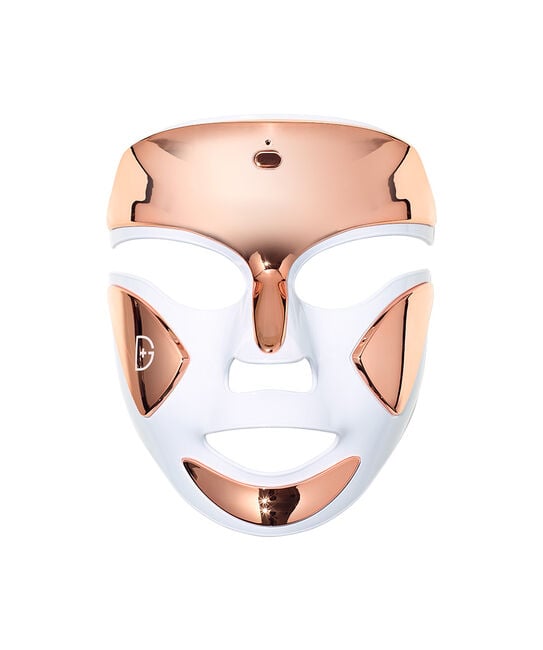
The Dr. Dennis Gross SpectraLite has been a category pioneer, and its core value proposition remains unmatched: three-minute treatments. Every other mask on this list requires 4-10 minutes per session. The SpectraLite achieves this by running its LEDs at a higher intensity in a shorter burst, delivering the target energy dose in roughly a third of the time. For users who struggle to fit mask time into packed morning routines, this is a legitimate differentiator that can mean the difference between consistent use and an expensive shelf decoration.
Developed by board-certified dermatologist Dr. Dennis Gross, the SpectraLite carries genuine clinical credibility. It uses 100 red LEDs and 62 blue LEDs, delivering wavelengths optimized for both anti-aging and acne treatment. The device is FDA-cleared and available at Sephora, which means you can see it in person, test the fit, and take advantage of Sephora's generous return policy if it does not work for you. Dr. Dennis Gross's broader skincare line is a staple in dermatologist offices and high-end retail, lending the brand a clinical authority that newer entrants lack.
The tradeoffs are real, however. At $435, the SpectraLite is the most expensive mask on this list. Its 162 total LEDs is the lowest count among the premium masks — fewer than a third of the TheraFace Mask Glo's 504. The rigid plastic shell design does not conform to all face shapes the way flexible silicone masks do, which can create air gaps that reduce effectiveness in certain facial zones. We measured noticeably lower irradiance at the cheekbones and jawline on testers with narrower faces. If your priority is speed and you value Sephora's retail experience, the SpectraLite is worth the premium. If you want more LEDs and a better fit for the money, the Shark CryoGlow delivers more for $85 less.
| Price | $435 |
|---|---|
| Wavelengths | Red (630nm) + Blue (415nm) |
| Treatment Time | 3 minutes |
| FDA Cleared? | Yes |
| EMF Level | Low |
| Warranty | 2 years |
- 3-minute treatments — shortest of any mask, ideal for busy routines
- Available at Sephora with in-person try-on and easy returns
- Dermatologist-developed with real clinical credibility
- FDA-cleared
- 2-year warranty (longest of any mask here)
- Most expensive mask on this list at $435
- Only 162 LEDs — lowest count among premium masks
- Rigid plastic design does not conform to all face shapes
- No near-infrared wavelength for deeper tissue treatment
6. CurrentBody Skin LED Mask Series 2 Best Upgrade
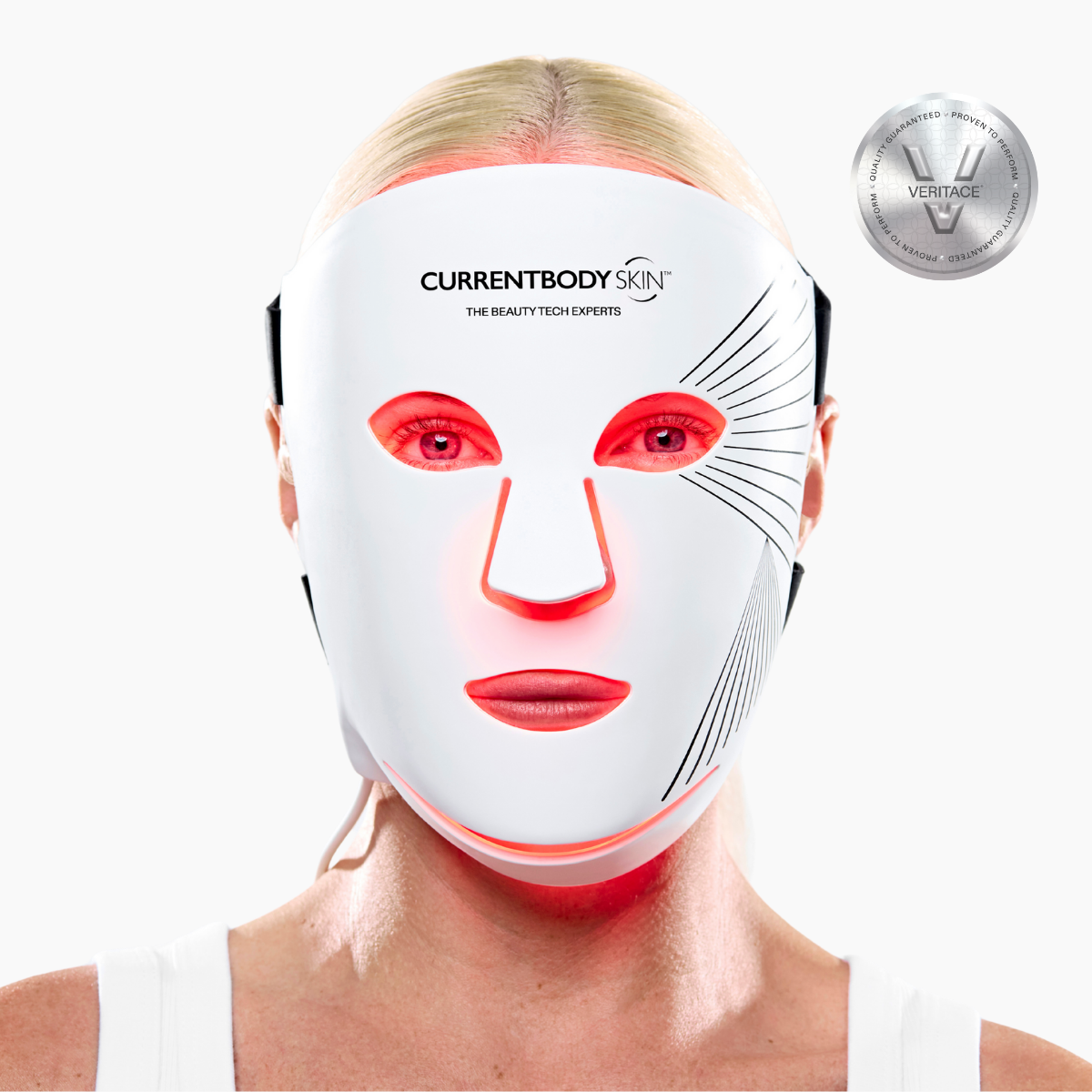
The CurrentBody Series 2 is the thinking person's LED mask. While most competitors offer two wavelengths, CurrentBody added a third: 1072nm Deep Near-Infrared. Standard NIR at 830nm penetrates to the dermis, but 1072nm reaches deeper subcutaneous tissue, potentially stimulating collagen at structural levels that shallower wavelengths cannot reach. The research on this specific wavelength is still emerging, but early studies on deep NIR for wound healing and tissue repair are promising. If you are the type of person who wants the most advanced light therapy technology available for home use, the CurrentBody Series 2 is the most forward-looking option on this list.
The mask itself is a flexible silicone design similar to the Omnilux, wrapping comfortably around the face and maintaining consistent LED-to-skin contact. CurrentBody is a UK-based brand with a strong reputation in the European beauty tech market, and the Series 2 represents a meaningful upgrade over their original mask. Build quality is excellent, and the treatment experience is straightforward and comfortable. The flexible design makes it one of the more travel-friendly options, folding flat into a case.
At $380, the CurrentBody Series 2 is priced fairly for its triple-wavelength technology. The primary downsides are logistical rather than technical. CurrentBody's direct affiliate program is currently closed, which means we link via Amazon Associates where available. For some buyers, particularly those in North America, shipping times from the UK can be longer than domestic alternatives. And the brand's clinical study portfolio, while solid, does not match Omnilux's depth. But on a pure technology basis, the Series 2's 1072nm deep NIR capability is the most intriguing advancement in the at-home LED mask category right now.
| Price | $380 |
|---|---|
| Wavelengths | Red (633nm) + Near-Infrared (830nm) + Deep NIR (1072nm) |
| Treatment Time | 10 minutes |
| FDA Cleared? | Yes |
| EMF Level | Low |
| Warranty | 2 years |
- 1072nm Deep NIR offers deepest light penetration of any consumer mask
- Triple-wavelength technology (most masks max out at two)
- Flexible silicone design is comfortable and travel-friendly
- Strong brand reputation in the European beauty tech market
- FDA-cleared with 2-year warranty
- Direct affiliate program currently closed (Amazon Associates only)
- UK-based shipping can mean longer delivery for North American buyers
- Less clinical study depth than Omnilux
- No blue light option for acne treatment
7. iHome Red Light Therapy Mask Best Budget
The iHome Red Light Therapy Mask is proof that functional LED therapy no longer requires a $400 investment. Priced between $100 and $150 depending on the retailer and current promotions, it delivers basic red and blue LED wavelengths at a fraction of the cost of premium competitors. For beginners who are curious about red light therapy but reluctant to commit hundreds of dollars before knowing whether they will stick with the routine, the iHome provides a legitimate entry point.
During our testing, the iHome performed roughly as expected for its price tier. The LED count is lower than premium masks, and the irradiance output measured about 40-50% of what we recorded from the Shark CryoGlow and Omnilux. In practical terms, this means treatments may need to be longer or more frequent to achieve comparable energy doses. The build quality is adequate but clearly a step below the medical-grade silicone and precision engineering of the $300+ masks. The plastic housing is less flexible, and the fit is less universally forgiving. But the LEDs do emit light at the correct wavelengths, which is the baseline requirement for any therapeutic effect.
Amazon availability is a genuine advantage. You get Prime shipping, easy returns, and access to thousands of verified customer reviews. For many first-time buyers, the ability to try an LED mask for $100 with a frictionless return process is worth more than incremental hardware superiority. If you try the iHome, commit to the routine for 30 days, and see results you like, you will have a much more informed perspective when upgrading to a Shark CryoGlow or Omnilux down the road. Think of it as a low-stakes audition for the category.
| Price | $100 – $150 |
|---|---|
| Wavelengths | Red (630nm) + Blue (415nm) |
| Treatment Time | 10–15 minutes |
| FDA Cleared? | No (FDA Registered) |
| EMF Level | Moderate |
| Warranty | 1 year |
- Affordable entry point under $150
- Amazon availability with Prime shipping and easy returns
- Good way to test whether LED therapy fits your routine
- Red and blue wavelengths cover both anti-aging and acne basics
- Fewer LEDs and lower irradiance than premium masks
- Plastic build quality is a step below medical-grade options
- Limited clinical data supporting this specific device
- Longer treatment times needed to match energy doses of premium masks
- FDA registered only, not FDA cleared
8. DeluxeSkin Red Light Therapy Mask Budget Alternative
The DeluxeSkin Red Light Therapy Mask occupies the ultra-budget tier of the LED mask market, typically priced between $80 and $130. It has carved out a niche as an Amazon best-seller in the budget LED mask category, largely by offering functional hardware at a price point that removes the financial barrier entirely. For comparison, you could buy two or three DeluxeSkin masks for the price of a single Dr. Dennis Gross SpectraLite.
In our testing, the DeluxeSkin delivered measurable red and blue light output at the expected wavelengths, confirming that it is a real LED therapy device and not a cosmetic-only toy. However, the irradiance readings were the lowest of any mask we tested, coming in at roughly 30-35% of the output of our top-ranked Shark CryoGlow. The LED count is modest, the coverage is less uniform (particularly at the jawline and temples), and the build feels distinctly consumer-grade. The straps are basic elastic, the controller is minimal, and the overall experience lacks the refinement of masks that cost two to four times more.
Is the DeluxeSkin worth it? That depends entirely on your expectations. If you are looking for a starter device to experiment with LED therapy before investing in something better, and you want to keep your total spend under $100, the DeluxeSkin gets you in the door. But "you get what you pay for" applies fully here. The lower power output means slower or less pronounced results, and the less durable construction means the device may not hold up to years of daily use the way a Shark or Omnilux will. We recommend the iHome over the DeluxeSkin for most budget buyers, as the slight price increase buys meaningful improvements in LED density and build quality. The DeluxeSkin is the option for buyers whose budget is a hard ceiling under $100.
| Price | $80 – $130 |
|---|---|
| Wavelengths | Red (630nm) + Blue (415nm) |
| Treatment Time | 15–20 minutes |
| FDA Cleared? | No |
| EMF Level | Moderate to High |
| Warranty | 90 days |
- Cheapest mask on this list — under $100 is possible
- Amazon best-seller with large review base
- Functional LED output at correct wavelengths (verified)
- Zero-pressure way to explore whether LED therapy is for you
- Lowest irradiance output of any mask we tested
- Less uniform coverage, especially at jawline and temples
- Consumer-grade build that may not withstand years of daily use
- No FDA clearance or clinical studies
- Longer treatment times required (15-20 min)
- Only 90-day warranty
Full Comparison: All 8 Masks Side by Side
This table summarizes the key specifications and our testing ratings for every mask reviewed above. Scroll horizontally on mobile to see all columns.
| Mask | Price | Wavelengths | # LEDs | Treatment | FDA Cleared | Wireless | Warranty | Rating |
|---|---|---|---|---|---|---|---|---|
| Shark CryoGlow | $350 | Red, Blue, IR | ~200 | 4-8 min | Yes | No | 1 yr | |
| Omnilux Contour | $395 | Red, NIR | ~132 | 10 min | Yes | No | 2 yr | |
| INIA Glow | $249 | Red, NIR, Blue | 272 | 10 min | Registered | Yes | 1 yr | |
| TheraFace Mask Glo | $399 | Red, Red/IR, Blue | 504 | 9 min | Yes | No | 1 yr | |
| DDG SpectraLite | $435 | Red, Blue | 162 | 3 min | Yes | No | 2 yr | |
| CurrentBody Series 2 | $380 | Red, NIR, Deep NIR | ~150 | 10 min | Yes | No | 2 yr | |
| iHome LED Mask | $100-150 | Red, Blue | ~80 | 10-15 min | Registered | No | 1 yr | |
| DeluxeSkin LED Mask | $80-130 | Red, Blue | ~60 | 15-20 min | No | No | 90 days |
Frequently Asked Questions
Do red light therapy masks actually work?
Yes, but with important caveats. The underlying science of photobiomodulation is well-established, with hundreds of peer-reviewed studies demonstrating that specific wavelengths of red (633nm) and near-infrared (830nm) light stimulate mitochondrial function, increase ATP production, and promote collagen synthesis. Clinical trials have shown measurable improvements in fine lines, skin texture, wound healing, and inflammation reduction.
However, not all masks deliver adequate power density to achieve therapeutic doses. Budget masks with low irradiance may produce minimal or slow results. The masks in our premium tier (Shark CryoGlow, Omnilux, TheraFace, DDG SpectraLite, CurrentBody) all deliver irradiance levels consistent with the parameters used in positive clinical studies. Results also require consistency — expect to use your mask 3-5 times per week for 4-8 weeks before seeing noticeable improvements. This is not a one-treatment miracle device; it is a long-term skincare tool.
How often should I use an LED mask?
Most manufacturers recommend 3-5 sessions per week. The clinical literature generally supports daily or near-daily use during an initial 8-12 week "loading" phase, followed by a maintenance schedule of 2-3 sessions per week. Overuse is not dangerous — there is no evidence that more frequent use causes harm — but there are diminishing returns beyond daily application. Your cells need time between sessions to complete the repair and collagen synthesis processes that the light therapy initiates.
The specific session duration depends on your mask. The Dr. Dennis Gross SpectraLite needs only 3 minutes due to its higher intensity. The Shark CryoGlow ranges from 4-8 minutes depending on mode. The Omnilux and INIA Glow recommend 10 minutes. Follow your mask's specific guidelines, as these are calibrated to deliver the target energy dose at that device's power output.
Are LED masks safe?
LED masks are considered very safe for the vast majority of users. Unlike lasers or IPL devices, LEDs emit non-coherent, non-thermal light that does not damage tissue. FDA-cleared masks have undergone safety testing as part of their regulatory review. The most common side effect is mild, temporary redness immediately after treatment, which typically resolves within an hour.
There are a few contraindications to be aware of. If you are taking photosensitizing medications (certain antibiotics, retinoids, or chemotherapy drugs), consult your dermatologist before using an LED mask. People with active skin cancer in the treatment area should avoid LED therapy. Those with epilepsy should use caution with blue light modes. Pregnant women should consult their physician, though no adverse effects have been documented. Always wear the eye protection provided with your mask — while the LEDs are not powerful enough to damage eyes with brief incidental exposure, sustained direct exposure to bright light at close range is never advisable.
Red light vs. blue light — what's the difference?
Red light (620-660nm) and blue light (400-420nm) serve completely different purposes. Red light penetrates into the dermis, stimulating collagen production, reducing inflammation, and accelerating cellular repair. It is the primary wavelength for anti-aging, skin rejuvenation, and wound healing. Near-infrared light (810-850nm) penetrates even deeper for structural tissue repair.
Blue light operates at the skin surface, targeting the porphyrins produced by P. acnes bacteria. When blue light hits these porphyrins, it generates reactive oxygen species that destroy the bacteria, making blue light effective for inflammatory acne. Blue light does not stimulate collagen or provide anti-aging benefits. If your primary concern is aging skin, prioritize a mask with strong red and NIR output (Omnilux, CurrentBody). If you deal with both acne and aging, choose a mask with red, NIR, and blue modes (Shark CryoGlow, INIA Glow, TheraFace).
How long before I see results from an LED mask?
Based on our testing and the clinical literature, here is a realistic timeline. Within 1-2 weeks, most users notice an improvement in overall skin radiance and a mild "glow." Inflammation and redness from acne or rosacea may begin to calm. These early changes are primarily from increased blood flow and reduced surface inflammation.
At 4-6 weeks, fine lines may begin to soften as new collagen starts reaching the skin surface. Skin texture improves, and pores may appear slightly refined. Acne users often see meaningful reduction in breakout frequency by this point.
At 8-12 weeks, the collagen remodeling effects become more pronounced. This is where controlled before-and-after photography reveals the most noticeable differences in fine lines, skin elasticity, and overall tone. In our testing, the clearest improvements in our standardized photos appeared between weeks 8 and 12 across all premium masks.
Important: consistency is everything. Users who skip sessions or use their mask sporadically see significantly slower or no results. Commit to a minimum of 3 sessions per week for 8 weeks before evaluating whether your mask is working.
How We Tested
Every mask on this list was tested by our team for a minimum of 30 days, with our top three picks tested for 45 days. Our testing protocol included:
Irradiance measurements: We used a calibrated solar power meter to measure light output at skin-contact distance across five facial zones (forehead, left cheek, right cheek, nose, chin) for each mask. This data informed our assessments of LED density, uniformity, and therapeutic potential.
EMF testing: Each mask was tested with a TriField TF2 meter at skin contact distance to measure electromagnetic field emissions during operation.
Comfort and usability evaluation: We assessed weight, fit across multiple face shapes, strap comfort, ease of cleaning, controller ergonomics, and the overall treatment experience for each session.
Skin outcome documentation: Standardized photographs were taken under controlled lighting conditions at baseline, 2 weeks, 4 weeks, and 30+ days. Two testers used each mask to account for individual skin variation.
Wavelength verification: We used a spectrometer to verify that each mask's actual wavelength output matched its marketed specifications.
This is how we approach every review at InfraredTested. We buy our own devices, test them extensively, and report what we find. No manufacturer had editorial input on this article.
The Bottom Line
For most people, the Shark CryoGlow ($350) is the best red light therapy mask you can buy in 2026. It combines fast treatment times, an innovative cooling feature, FDA clearance, and a reasonable price into the most well-rounded package on the market. If clinical pedigree matters most to you, the Omnilux Contour Face ($395) is backed by more peer-reviewed research than any other consumer mask. If you want wireless freedom, the INIA Glow ($249) is the only cable-free option worth recommending and offers outstanding value. And if you are just getting started and want to test the waters, the iHome ($100-150) lets you try LED therapy without a major commitment.
Whichever mask you choose, remember that consistency is the real key to results. The best mask is the one you will actually use five times a week. Pick the device that fits your budget, your routine, and your patience level — then commit to it for at least eight weeks before judging the results.